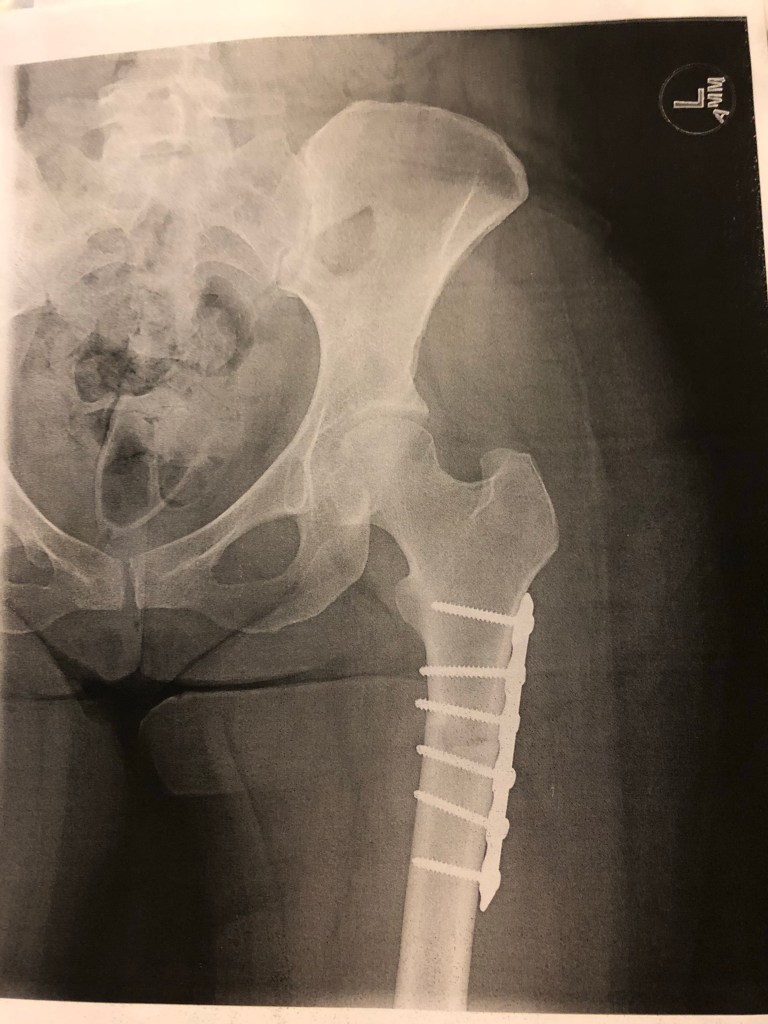
My left femur plate. The break is between the third and fourth screws. 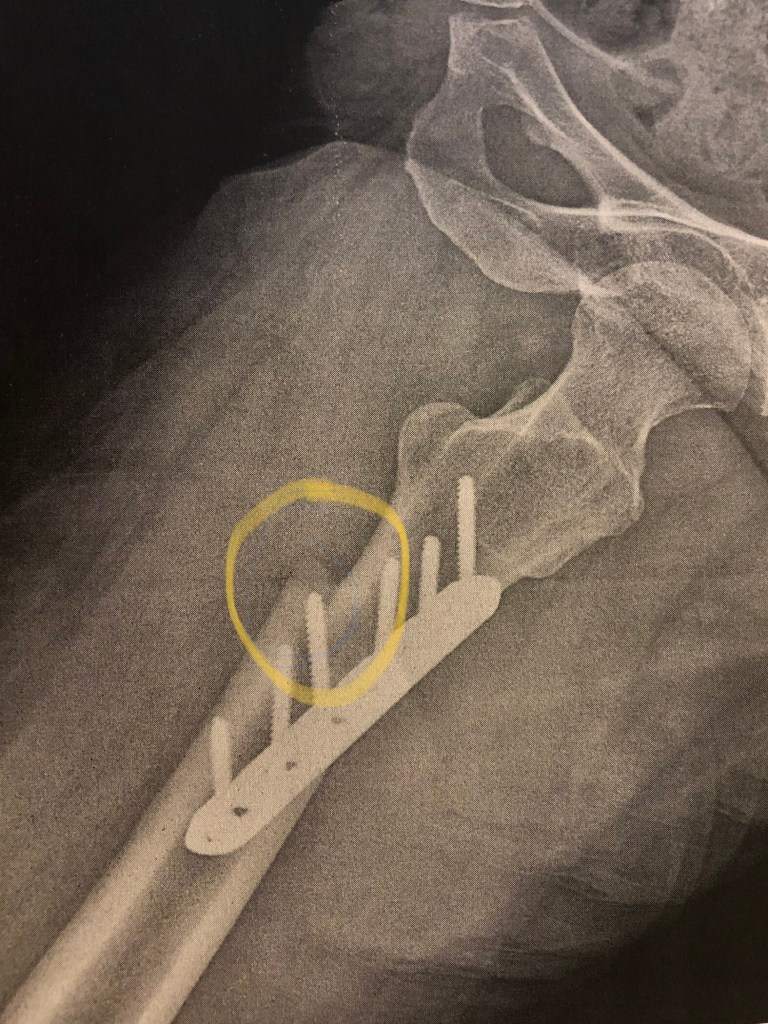
A side view of the left femur. The yellow circled area shows just how big of a rotation the bone underwent. It will eventually heal straight. 
My right femur plate. The break was between the third and fourth screws.
Orthopedic surgery is, in a word, barbaric. Surgeons intentionally break bones and cut through muscles, tendons, ligaments, cartilage, nerves and whatever else is in their way to reach their target. They use specialized power tools to saw bone, drill holes and insert screws, plates, rods and other metalware into the bones to put them back together — almost always in a different orientation than they originally were.
To paraphrase the words of a friend who also has had many orthopedic surgeries, with most surgeries you’re usually starting to round the corner, feel pretty good or maybe even feel “normal” by four weeks post-op. With orthopedic surgeries, though, it’s not unusual to still be on some dose of prescription pain medication at four weeks post op. If it was a procedure on a weight-bearing joint, you’re not even close to walking by then.
Barbaric.
I’m typing this while I’m lying in bed, my left leg in a continuous passive motion machine, and my left femur cut cleanly in half, the bone held together by a metal plate and six screws from the femoral osteotomy I had at the Cleveland Clinic Dec. 1. In November 2019, I had the same procedure on my right femur. Five other surgeries since 2015 addressed bony overgrowth in the joints, torn labrums, damaged cartilage and more.
It seems counterintuitive, then, to marry “civility” and “broken femur” in this post’s title. I’m part of several Facebook groups that are communities of people with hip problems like mine who have undergone many surgeries, too. They’re a wonderful resource, sharing experiences, uplifting others and offering new perspectives along this challenging medical journey. Someone recently shared a quote from anthropologist Margaret Mead (paraphrased below) that got me thinking.
The first sign of civilization in an ancient culture was a femur that had been broken and then healed. In the animal kingdom, if you break your leg, you die. You cannot run from danger, get to the river for a drink or hunt for food. You are meat for prowling beasts. No animal survives a broken leg long enough for the bone to heal.
A broken femur that has healed is evidence that someone has taken the time to stay with the one who fell, has bound up the wound, has carried the person to safety and has tended the person through recovery. Helping someone else through difficulty is where civilization starts.
Margaret Mead
Mead’s definition of civility was somewhat surprising. I always associated early civilization with crude housing and communities, cooking wild game over a campfire or even perhaps inventions like the wheel or a pail to collect and carry water. She argues, however, that it has nothing to do with such materials and everything to do with relationships and community-mindedness. It’s a beautiful perspective, and one we should never lose sight of. This led me to reflect on those who are helping me through difficulty with my own broken femur.
- The hospital staff. I cannot speak highly enough of the hospital staff during my femoral osteotomies, from my pre-op nurse and anesthesiologist, through the surgeon, PA and especially the hospital nursing staff. Despite having a 13-month gap between my osteotomies, many of the nurses, physical and occupational therapists at Cleveland Clinic remembered me. I truly felt cared for as a human being and not just as one of the thousands of patients they tend to every year.
- Brian. My hospital stays were the easy part. I had an entire team of professionals tending to me who were experienced in post-operative care for osteotomy patients. When the pills weren’t effective pain management, they offered intravenous solutions pronto. But coming home? Coming home was awful. Brian had the gargantuan task of avoiding as many potholes as possible (not an easy feat in northeastern Ohio and western Pennsylvania!) and getting me from the car into our house while I was so shaky I could barely support myself. Then it got harder. He set his alarm for every four hours round-the-clock to administer my pain medication. (One of the keys to orthopedic surgery is always staying ahead of the pain). He brings me meals, keeps the household running and, most importantly, takes complete responsibility for Landon.
- Family. Our families are pillars of support. We’re fortunate enough to live near my parents and my brother and his family, all of whom make sacrifices of their time and energy to watch Landon, cook meals, transport me, help clean the house and so much more.
- Friends. We have a group of friends that we count as family. We grew up side by side and now we’re raising our children side by side. I know I can always count on them to help.
- Church Community. Our mailbox is filled with cards from our church community and our refrigerator and freezer are filled with meals from them as well.
There is some beauty in these interminably long periods of pain and recuperation as I realize how loved we are and how our community is figuratively carrying us through this time. (At times, Brian quite literally carries me through this!)
As we near the end of 2020, many could argue it was an ugly year. A year filled of bitter disagreements, protests, polarizing statements and more. All of that is true. But if you look further, you’ll see many more stories of families spending more time together and strengthening or rebuilding bonds, of neighbors helping neighbors and of communities banding together and supporting small businesses and the people behind them. An interview source told me weeks ago that he views this year as a bit of a “reset” button. Despite the turmoil outside our homes, it’s a time to grow closer and focus on family and what truly matters without the interruptions of scheduled activities, commuting and other buzz we fill every moment with.
On a personal level, 2020 is a continuation of realizing how fortunate I am to be a part of the family and community I’m in. From the time Landon was born in 2018 amid life-threatening complications, through my first osteotomy in 2019, my latest osteotomy a few weeks ago, and the five other hip surgeries in recent years, we’ve been showered with love, support and almost more meals than our refrigerator can handle.
It’ll be months before I’m healed enough to walk without crutches, and many more months of hard work after that before I’m rehabilitated enough to resume normal activities. Through every setback and celebration, I know my community will be by my side and carry me through.

 The Story of Our Lives
Leave a reply to A Farewell to Fombell – Fombellina Cancel reply